Shop
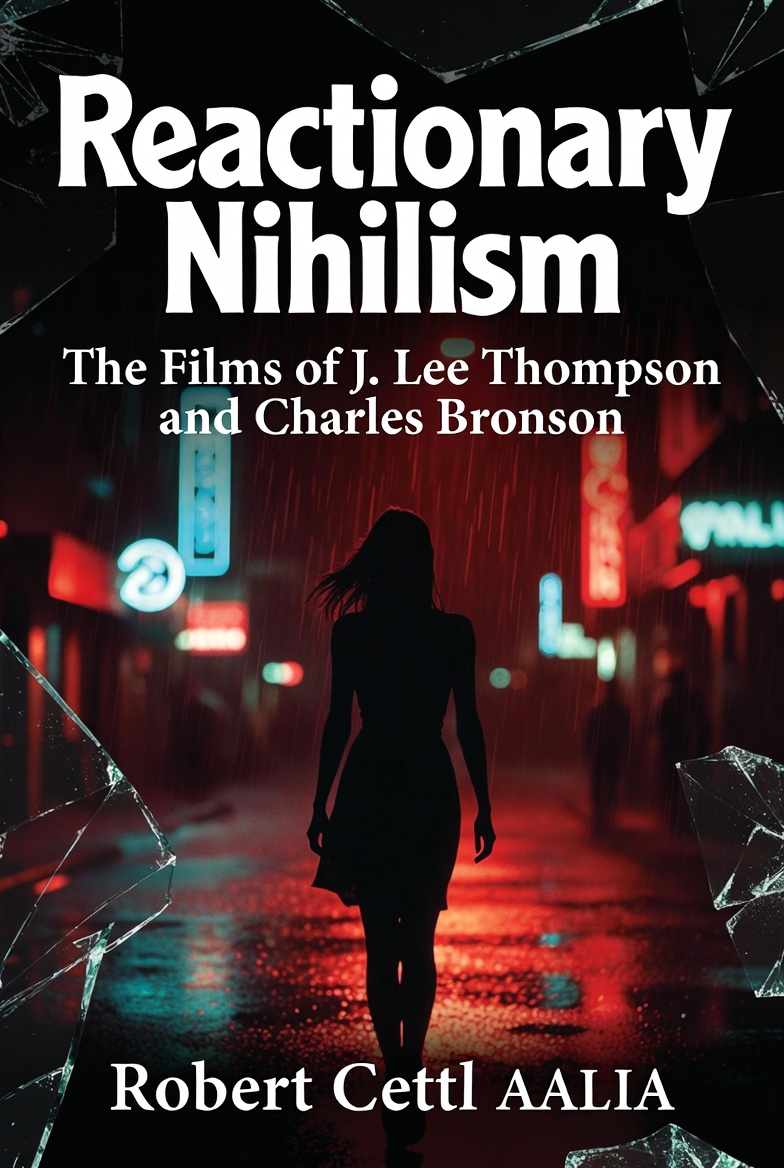
Reactionary Nihilism: The Films of J. Lee Thompson & Charles Bronson
This study examines the long and often controversial collaboration between director J. Lee Thompson and actor Charles Bronson, tracing its evolution from the mid-1970s through the 1980s. Their partnership produced some of the most commercially successful and culturally divisive films of the era. Rather than dismissing these works as simple exploitation or vigilante fantasy, this book argues that Thompson and Bronson developed a distinctive cinematic worldview — one the author terms reactionary nihilism.
Description
Description
Reactionary Nihilism: The Films of J. Lee Thompson & Charles Bronson
by Robert Cettl AALIA
FORTHCOMING: 2027/01/26 (INVASION / AUSTRALIA DAY)
This study examines the long and often controversial collaboration between director J. Lee Thompson and actor Charles Bronson, tracing its evolution from the mid-1970s through the 1980s.
Their partnership produced some of the most commercially successful and culturally divisive films of the era. Rather than dismissing these works as simple exploitation or vigilante fantasy, this book argues that Thompson and Bronson developed a distinctive cinematic worldview — one the author terms reactionary nihilism.
Their films repeatedly depict a society in moral and social collapse, where traditional institutions have failed and the individual is left with only violence as a response. This bleak vision is explored across their key collaborations, including St. Ives, The White Buffalo, Cabo Blanco, 10 to Midnight, The Evil That Men Do, Messenger of Death, Murphy’s Law and Kinjite: Forbidden Subjects.
Drawing on close textual analysis, production histories, and the broader cultural context of post-Vietnam and post-Watergate America, Reactionary Nihilism positions UK expat director Thompson and international star presence Bronson as key figures in the development of a particularly American form of cinematic pessimism — one that combined the moral certainties of the Western with the urban alienation of film noir, while anticipating the rise of the modern action thriller.