Shop
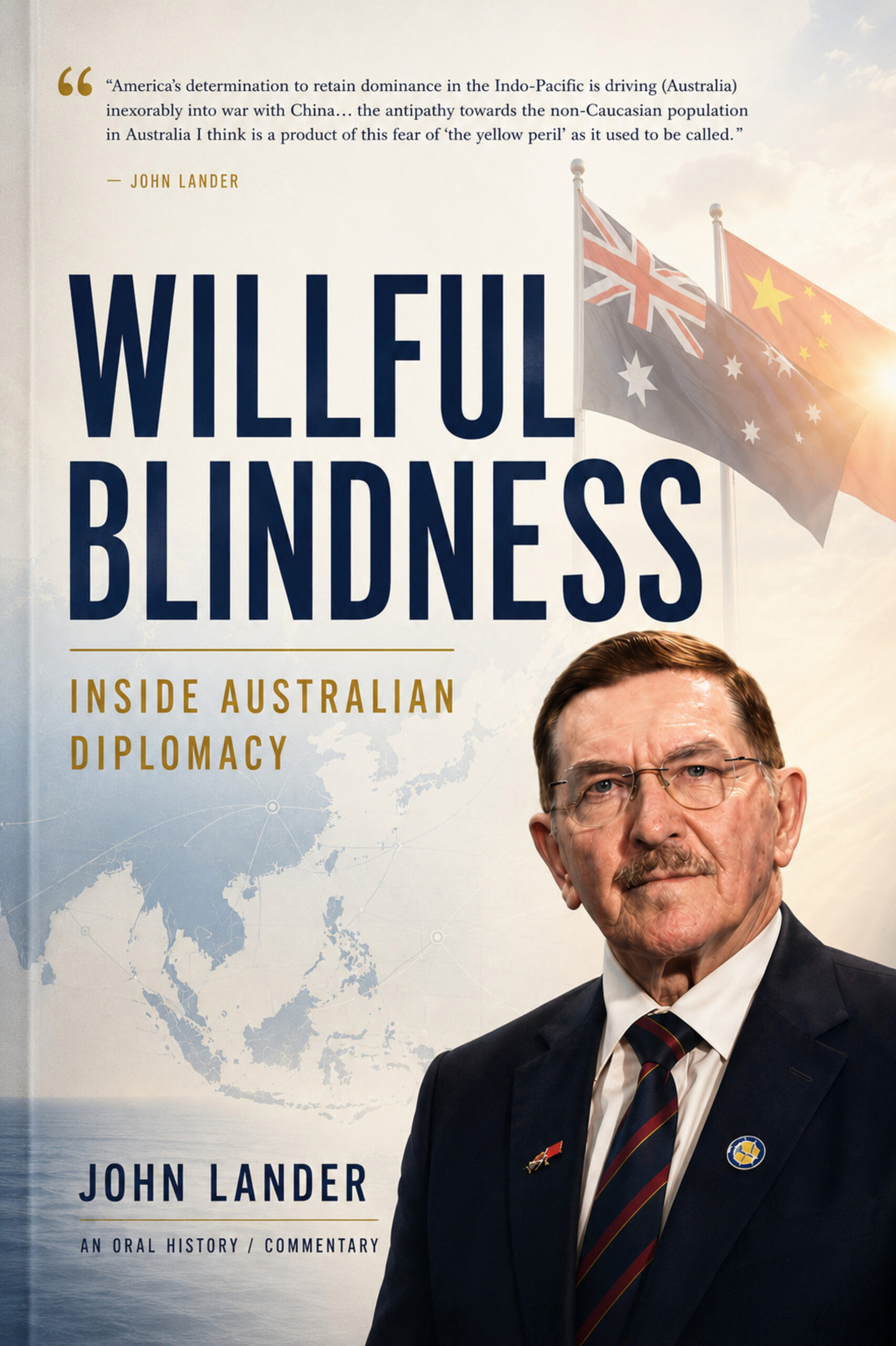
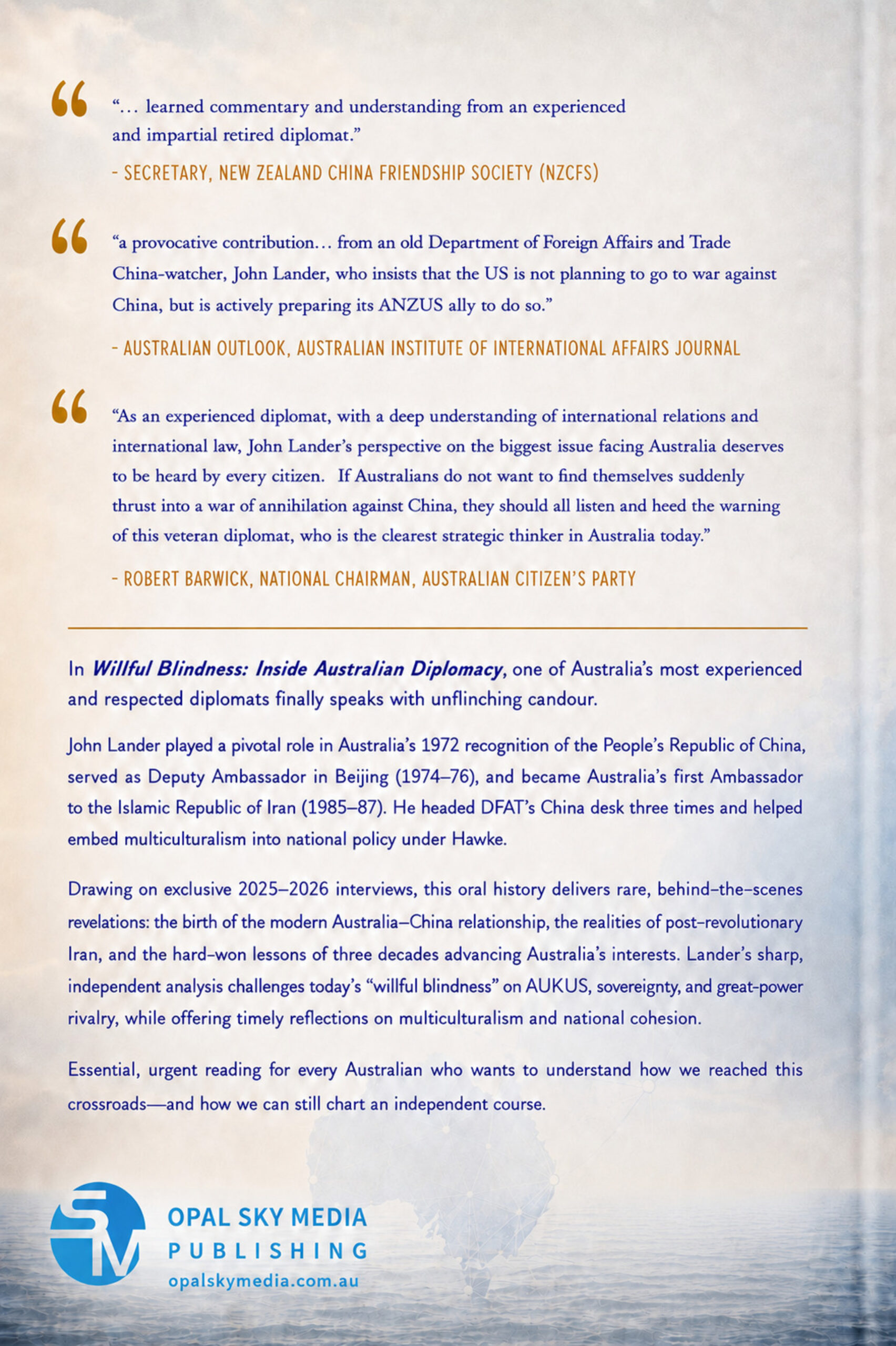
Willful Blindness: Inside Australian Diplomacy (John Lander Oral History / Commentary)
$24.99
A gold-standard primary diplomatic corpus. This volume presents the first comprehensive oral history of veteran Australian diplomat John Lander, with contextual exegesis, footnotes and full APA references. Lander served in the Department of Foreign Affairs China section during the critical 1971–1972 period leading to recognition of the People’s Republic of China. He was Deputy Ambassador in Beijing (1974–1976, including periods as Chargé d’Affaires) and Australia’s first Ambassador to the Islamic Republic of Iran (1985–1987). Later, as Director of the Economic and Commercial Section of the Office of Multicultural Affairs under the Hawke and Keating governments, he was tasked with putting “flesh on the bones” of the core tenet that diversity is an economic strength — work never previously documented in this form. Note: Views are John Lander’s personal recollections and analysis; not official Australian Government positions.
Description
Description
Willful Blindness: Inside Australian Diplomacy
John Lander -an Oral History & Commentary)
edited by Robert Cettl AALIA
ISBN# 978-1-923292-07-9
[PDF version of print edition]
“I value this book because it encourages us to reopen questions that are too often concealed beneath convenient answers. Over the past four decades, China has experienced one of the most significant social and economic transformations in human history… A transformation of such magnitude cannot be understood through a single expression of praise or criticism. It requires us to examine China’s capacity for long-term planning, the implementation of national priorities through local experimentation, the contribution of education and infrastructure, the efforts of its people and the willingness of its institutions to adjust policies in response to changing circumstances. It also requires us to recognise complexity.”
(Richard Yuan JP, from the Introduction)
A gold-standard primary diplomatic corpus. This volume presents the first comprehensive oral history of veteran Australian diplomat John Lander, with contextual exegesis, footnotes and full APA references. Lander served in the Department of Foreign Affairs China section during the critical 1971–1972 period leading to recognition of the People’s Republic of China. He was Deputy Ambassador in Beijing (1974–1976, including periods as Chargé d’Affaires) and Australia’s first Ambassador to the Islamic Republic of Iran (1985–1987). Later, as Director of the Economic and Commercial Section of the Office of Multicultural Affairs under the Hawke and Keating governments, he was tasked with putting “flesh on the bones” of the core tenet that diversity is an economic strength — work never previously documented in this form. Note: Views are John Lander’s personal recollections and analysis; not official Australian Government positions.
The “China Section” as Lived Experience
In the early 1970s, John Lander served as a junior officer in the China section of the Department of Foreign Affairs (later DFAT) during the decisive period that led to Australia’s recognition of the People’s Republic of China.
In the early 1970s the China section worked against more than twenty years of non-recognition of the People’s Republic of China (PRC). Since the 1940s, Australia had maintained relations with the Republic of China (ROC) on Taiwan, but the Australian Labor Party (ALP) had recently favoured recognition of Beijing. By 1971–72 the external and domestic settings were shifting quickly, and officers prepared material for either election outcome, with ALP leader Gough Whitlam pledging to recognize the PRC if elected. Whitlam’s July 1971 visit to China as Opposition Leader signalled the ALP’s intention to move rapidly if it won office and prompted preparatory work inside the Department:
- The Nixon–Kissinger opening and the February 1972 Shanghai Communiqué further reduced the earlier constraint of close alignment with US non-recognition.
- Officers therefore drafted dual-track options and background papers—one for continued relations with the ROC under a Coalition government, and another for recognition of the PRC under Labor—while Australia still maintained an embassy in Taipei.
- Once Whitlam took office in December 1972, these drafts enabled the rapid negotiation and conclusion of the Joint Communiqué in Paris within weeks.
Lander was involved in the documentation, policy advice and practical preparation that supported the negotiation of the Joint Communiqué signed in Paris on 21 December 1972. He has recalled contributing to the formulation of the key Taiwan clause, in which Australia “recognises the Government of the People’s Republic of China as the sole legal Government of China” and “acknowledges the position of the Chinese Government that Taiwan is a province of the People’s Republic of China.”
In his account, the word “acknowledges” was understood at the time of drafting as carrying the sense of “recognised and accepted.” On the day of issuance, however, the Department circulated secret cables to Australian posts explaining that “acknowledges” should be treated as closer to “take note of,” and that the removal of official representation from Taiwan followed from recognition of the PRC government rather than from any separate territorial concession. The Chinese-language version used the same character for both “recognises” and “acknowledges,” a point that has remained part of the interpretive history of the document.
“With the revelation that the US was moving to the recognition of the People’s Republic of China, plus the fact that Gough Whitlam as leader of the Opposition had already declared that were he to win government he would immediately recognize the PRC and of course he visited China as leader of the Opposition in 1971. And of course he did win the election in 1972. We had spent all that time in the lead-up to the election preparing for the transition from recognition of the ROC to the recognition of the PRC. So I was also involved, as a very junior officer at the time in the documentation and preparation of advice and so on regarding the negotiations for the Joint Communique on the Recognition of the PRC. That led fairly quickly to the formulation of the wording that is now in the Joint Communique of the Recognition of the PRC which acknowledged, that is recognized and accepted, the position of the PRC that Taiwan is a province of China. The narrative these days, that somehow Taiwan is separate from China and must be protected from any ‘invasion’ by China, is a false narrative.”
Lander’s China section years therefore sit at the intersection of a major foreign-policy reversal and the day-to-day work of making recognition operational. The oral history records both the internal departmental processes and his recollection of the intended meaning of the carefully negotiated language that has remained the foundation of Australia’s one-China policy. The account is presented as personal testimony and analysis, not as an official government history, and is accompanied by contextual commentary on the subsequent evolution of that policy.
Ambassadorship to the Islamic Republic of Iran
In 1985 John Lander became Australia’s first Ambassador to the Islamic Republic of Iran, restoring full ambassadorial representation after several years of chargé d’affaires-only presence.
Australia had opened an embassy in Tehran in 1968 under the Shah, but relations at ambassadorial level were suspended after the 1979 revolution and the seizure of the American embassy. The Hawke government decided to return an ambassador as bilateral trade and political contacts gradually recovered.
“It was evident to me then, I got into a bit of trouble with our intelligence boffins in Canberra for saying so, but it was evident to me then that the United States was using Iraq as its proxy to confront the Islamic Republic of Iran and to weaken it and in fact even to overthrow the government, which was the first government in the history of Iran to set up a democratic electoral system. Its clear to me, though its not clear to many people, that Israel is a proxy of the United States in the conduct of the US geopolitical strategy in the Middle East, or West Asia. So the Israeli attacks on Iran, taking out the leadership of the IRGC, the Iran Revolutionary Guard Corps, and the subsequent bombing by the United States of Iran’s nuclear research facilities had really nothing to do with the non-existent nuclear development program of Iran, because it was non-existent. It had to do with part of a strategy of attempting to disrupt Iran and if possible detach it from China’s Belt & Road, and to detach it from collaboration with China.”
Lander’s appointment was presented as recognition of that improvement and of the scope for further commercial growth. He took up the post in the middle of the Iran–Iraq War. Travel was delayed while he waited in London for Iraqi air raids on Tehran to ease; once in the capital he operated under wartime conditions. He had completed a short course in Farsi before arrival and presented his credentials to President Ali Khamanei in Persian, an unusual step among Western envoys that was noted favourably and helped establish a more direct working relationship. During his tenure he worked to expand trade and practical cooperation in areas such as dry-land farming and engineering support for water-storage infrastructure.
Lander left Tehran in early 1988, shortly after Iran accepted the United Nations resolution that ended the war. The posting therefore combined the practical work of rebuilding a bilateral relationship under difficult conditions with firsthand observation of a major regional conflict and of the early institutions of the Islamic Republic. As with his China-section testimony, the oral history presents these as personal recollections and analysis rather than official government positions, set against the broader context of Australia’s Middle East policy and its alliance relationships in the mid-1980s.
At the Office of Multicultural Affairs
After returning to Canberra, John Lander became Director of the Economic and Commercial Section of the Office of Multicultural Affairs (OMA) , the Hawke-era body charged with implementing the 1989 National Agenda for a Multicultural Australia.
That document formally recognised that Australia was already a multicultural society and set out a framework for managing existing diversity so that it contributed to national economic and social strength rather than remaining a matter of cultural celebration alone. Lander’s role at the OMA, ostensibly under the Keating ALP government, was to turn the claim that diversity was an economic asset into practical measures. He advanced “productive diversity,” developing programs (including VidPak) to link immigrant workers’ skills and networks with industry and trade opportunities.
“For quite a considerable time after the end of the second World War, with the arrival of immigrants from Western Europe, the policy was to maintain what Sir Robert Menzies called a “homogeneous” population in Australia, which even at that time was disingenuous because the Australian population was already not homogeneous because it ignored the fact that we had First Nations peoples, we had an indigenous population already in Australia which was hardly homogeneous with the white Australia that Menzies was promoting. It wasn’t until after Whitlam was elected that Australia began to move to formally recognizing the very existence of the Aboriginal population as legitimate citizens of the country. So by the time Bob Hawke was Prime Minister, the national agenda for a multicultural Australia was formulated and publicly in 1989. Shortly after that I was working in the Office of Multicultural Affairs, which Bob Hawke set up as an arm of the PM’s department. There were various chapters in the national agenda, the preface of which made it very clear that the purpose of the national agenda was to recognize the fact that Australia was already very multicultural. The purpose of the national agenda was to formalize and acknowledge the fact that Australia was a multicultural society. And to take a deliberate and structured approach to making use of the fact that we were multicultural to get as much benefit from the diversity, a linguistic, cultural, ethnic, religious diversity in Australia could be turned to Australia’s advantage, particularly economically. So I was appointed the director of what was known as the Economic and Commercial Section of the OMA and my task was to put flesh on the bones of the proposition that… diversity was an economic asset.”
Lander’s brief was to give practical content to the claim that linguistic, cultural, ethnic and religious diversity constituted an economic asset. He advanced the concept of “productive diversity,” developing programs intended to demonstrate how the skills and networks of immigrant workers could be integrated into Australian industry and commerce. One such initiative was VidPak, which aimed to link diverse workforces with specific commercial opportunities. The work involved translating the high-level language of the National Agenda into operational measures focused on workforce participation, trade facilitation and the economic utilisation of existing demographic diversity.
This phase of Lander’s career has received little previous public attention, and the oral history records his account of the intent behind the 1989 Agenda, the practical steps taken to implement the economic dimension of multicultural policy under the Hawke and Keating governments, and his assessment of the longer-term effects of those institutional arrangements on workforce integration and social cohesion. As with his foreign-policy testimony, the material is presented as personal recollection and analysis, situated against the policy context of the period and the subsequent evolution of Australian approaches to multiculturalism.